
The Economics of On-Site Endodontics
Where the value actually comes from and what practice owners should understand before adding recurring specialty capacity.
THE KEY IDEA
The fee charged for a root canal matters, but the larger economic result is determined by how much diagnosed demand can be converted into completed treatment, how efficiently the specialty day uses reserved clinical capacity and who carries the cost when that capacity is not full.
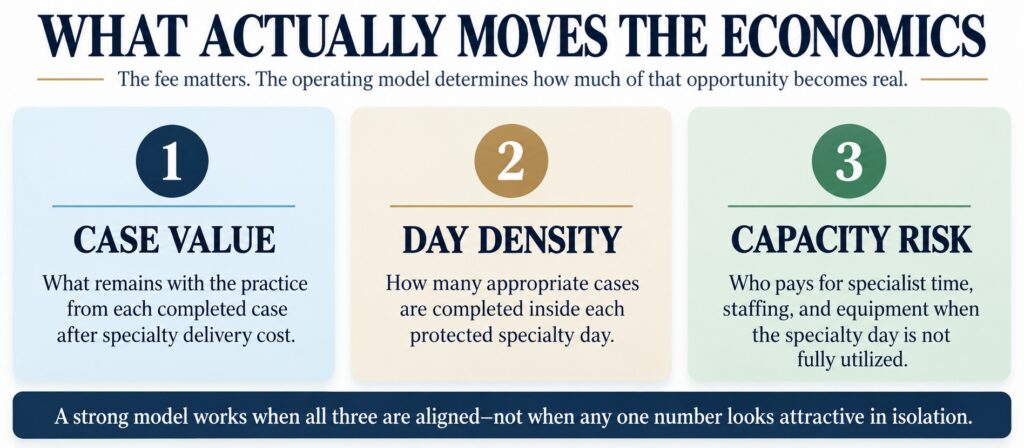
A Root Canal Fee Does Not Tell You Whether the Model Works
The fee a practice charges for endodontic treatment absolutely matters. It establishes the size of the opportunity. But the fee alone does not tell the owner how much value an on-site model can actually create. That depends on what happens to the case today, how densely specialty treatment can be scheduled, and who carries the cost of unused specialist capacity.
That creates two very different economic starting points. When a case is currently referred out, bringing it on-site retains endodontic production that otherwise leaves the practice. When the GP currently performs the case, the endodontic production is already in-house; the opportunity is to release GP time for other productive care. From there, specialty-day density and capacity risk determine how efficiently either opportunity is converted into value. Those distinctions are easy to miss because the clinical procedure is the same in each scenario although the economics are not.
WHAT THE PRACTICE IS ACTUALLY BUYING
The practice is not simply paying someone to perform a root canal. It is gaining specialist capacity, trained support, equipment and the clinical infrastructure required to keep appropriate treatment in-house—without first building an internal specialty department. For cases that would otherwise leave the practice, the economic value is the endodontic production retained after that specialty delivery cost.
Start With Existing Demand, Not Forecasted Growth
The strongest economic case usually begins with treatment the practice is already diagnosing. A practice does not need to assume that an on-site program will create a new category of patient demand. It needs to understand how many appropriate endodontic cases already exist, where those cases currently go, and how consistently they could be consolidated into recurring specialty days. That distinction matters because existing demand is measurable. It turns the discussion from “How much endo could we do?” into “How much endo are we already diagnosing, and what operating path gives that demand the most useful home?”
INSIGHT 1
The Economics Improve as the Day Becomes Denser
A specialty day consumes something a dental practice cannot manufacture: clinical capacity. Treatment rooms are reserved for specialty care, the schedule is built around those cases, and the team integrates the specialty day into the normal flow of the practice. The economic value of that day therefore depends on how much completed treatment is produced from that reserved block of time. This is why completed case density is more important than simply having access to an endodontist. A lightly used day and a full day may require similar operational preparation, but they produce very different value for the practice. The relevant unit is not only the individual root canal. It is the productivity of the specialty day itself.
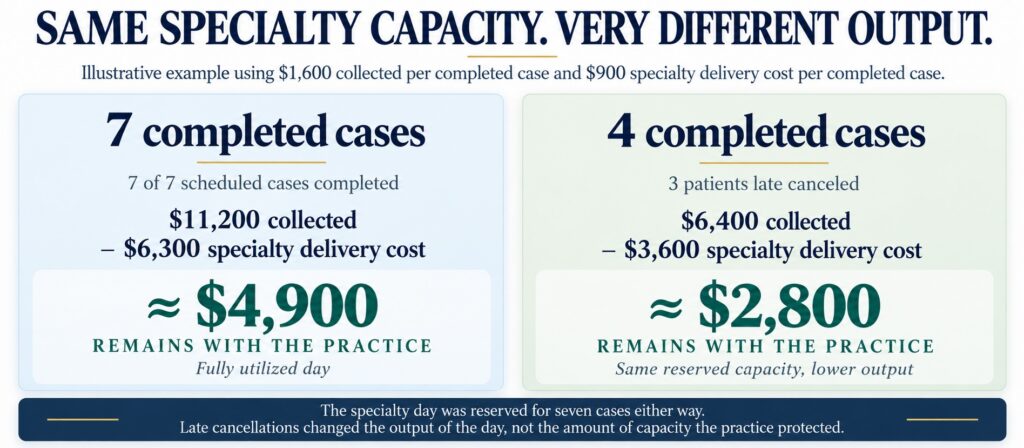
Exact dollar amounts are illustrative only. Comparison is intended to show value produced from the same reserved specialty day.
A seven-patient schedule with three late cancellations is economically a four-patient day. The calendar can look full while the specialty capacity is not. This is why case identification, patient readiness, scheduling discipline and cancellation management are economic functions, not merely administrative ones.
WHAT THIS CHANGES
A practice evaluating on-site endodontics should ask how reliably it can build and complete a dense specialty day, not merely whether it sees enough root canals over the course of a month.
INSIGHT 2
On-Site Care Changes Who Carries the Capacity Risk
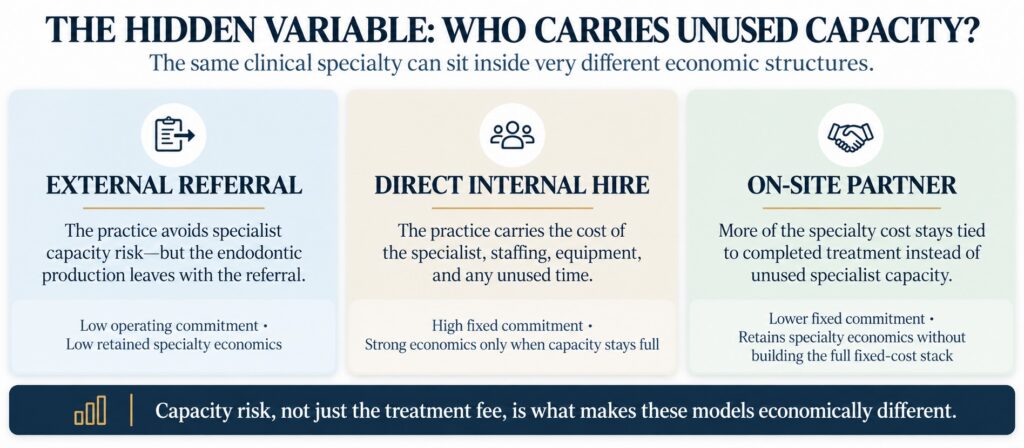
The largest hidden economic difference between specialty delivery models is often not the clinical fee. It is who pays for unused capacity. A traditional referral keeps specialist capacity outside the practice. The office does not pay for an endodontist, specialty assistants, equipment or idle specialist time, but it also sends the endodontic production away from the practice.
A direct internal hire does the opposite. The practice can keep the specialty production, but it assumes a much larger fixed-cost structure: recruiting, compensation, specialty staffing, equipment, supplies, management and the cost of time that is paid for whether the schedule is full or not. At enough scale, that can be an excellent model. Below that scale, unused capacity becomes expensive.
An on-site partner model occupies the middle. The practice gains recurring specialist capacity without first building the entire specialty department itself. More of the specialist expense can remain tied to treatment actually completed rather than to the mere availability of the specialist.
WHY THIS IS STRATEGICALLY IMPORTANT
A practice does not have to decide only between “refer everything out” and “hire an endodontist.” The operating model can change the amount of specialty capacity the practice controls without requiring it to absorb the full fixed cost of a direct hire.
INSIGHT 3
Fewer Handoffs Keep More of the Treatment Path Inside the Practice
On-site endodontics creates value beyond the root canal treatment because it changes the path the patient follows after diagnosis. In the traditional referral model, the patient leaves the practice, enters a second scheduling and financial system, completes specialty treatment, and then has to return to the general dentist for definitive restoration. Every transition creates another opportunity for delay or lack of follow-through.
Keeping the specialty inside the dental home compresses that pathway from five handoffs to two. Diagnosis and scheduling stay within the practice, the endodontist treats on-site, and the patient remains connected to the same GP for restoration. The patient can move from diagnosis to specialty treatment without leaving the practice and the restorative plan remains connected to the same team. Fewer handoffs mean fewer places for scheduling, communication, finances or patient hesitation to interrupt completion. That increases the practice’s ability to carry diagnosed treatment through both the endodontic and restorative phases.
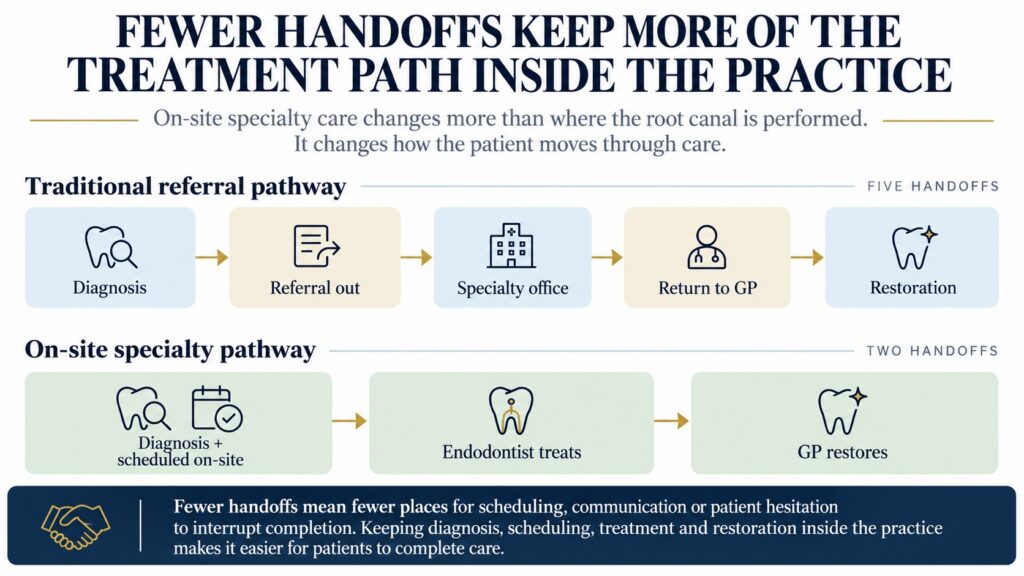
The restorative benefit is the increased likelihood that the patient follows through with the restorative treatment already planned.
That distinction matters because it keeps the economic case grounded in completed care rather than theoretical production. The on-site model retains the endodontic case and strengthens the pathway into the restoration that follows.
INSIGHT 4
The Economic Case Depends on Where the Root Canal Goes Today
There are two fundamentally different ways an on-site specialty program can create financial value, and they should not be blended into one calculation. If the case is currently referred outside the practice, bringing it on-site creates retained production. The practice is now performing and collecting for treatment that previously left the business. In that scenario, the endodontic fee is genuinely new production to the practice.
If the GP currently performs the root canal, the calculation is different. The practice already owns the endodontic production. Moving the case to a specialist does not create new endodontic revenue; it releases GP capacity. The value comes from what the dentist can now do with that time: restorative treatment, implants, diagnostics, same-day emergencies or other productive care that would otherwise have competed for the same schedule.
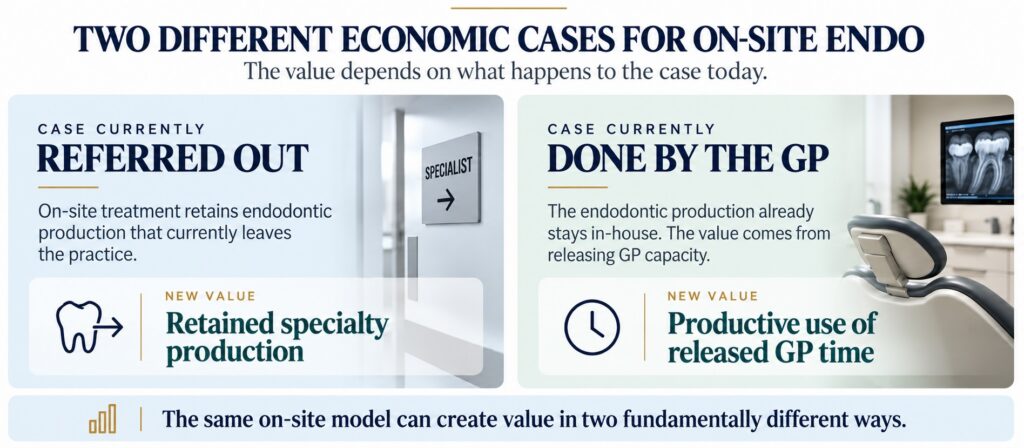
These two cases can exist inside the same practice. Referred-out cases create retained specialty production. GP-performed cases create doctor-capacity value. A useful economic model separates the two before combining them.
TWO DIFFERENT ECONOMIC CASES
Referred-out case: the endodontic production is newly retained.
GP-performed case: the production is already in-house, so the new value is the productive capacity released on the GP’s schedule.
INSIGHT 5
The Fee Still Matters But It Has to Be Viewed Inside the Delivery Model
A practice with a stronger patient-facing fee will generally have more room between the revenue generated by the procedure and the cost required to deliver the specialty care. That is a meaningful lever, and it belongs in any financial model. The practical calculation is what remains with the practice after the cost of delivering the specialty care. A case with a strong fee can still create weak economics if the delivery model is inefficient. Conversely, when the per-case economics are sound and the specialty day is dense, the same reserved block of time can produce substantial retained value for the practice.
That is why the economics should be viewed at two levels. The case-level view shows what the practice keeps when a root canal is treated on-site. The day-level view shows whether enough of those cases can be completed in the same block of specialty time to make the model meaningful.
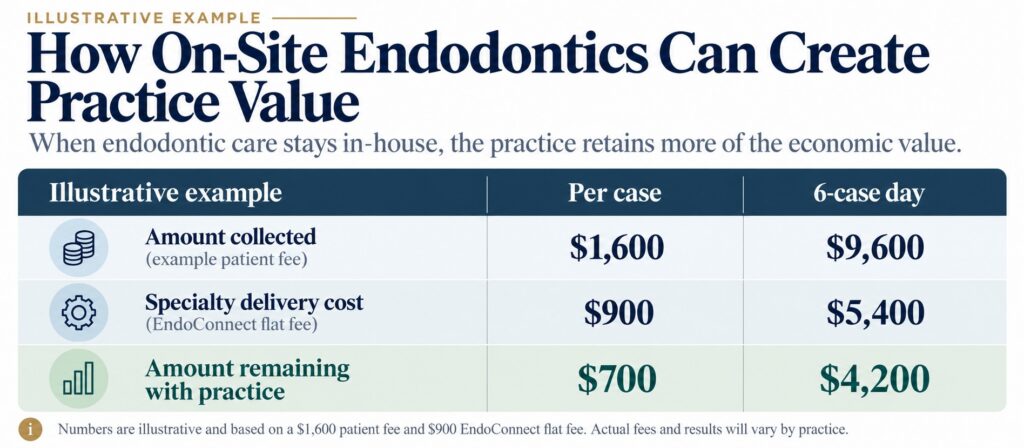
THE MODEL SHOULD BE ABLE TO SAY NO
When the Economics Probably Do Not Work
On-site specialty care is not a strong fit when the practice cannot consistently support enough appropriate treatment to use the specialty capacity it reserves. In most cases, the limiting factor is not the fee charged for treatment. It is whether diagnosed cases can be identified, scheduled and completed reliably enough to support the model. If the practice cannot consistently identify enough appropriate cases, cannot convert those cases into a recurring schedule, or repeatedly loses capacity to late cancellations and unprepared patients, the specialty day may never become dense enough to justify the operational effort. Likewise, a practice whose GPs already perform endodontics efficiently and have no better use for the released doctor time may see less financial benefit from changing the delivery model.
At the other extreme, an organization with very high, stable specialty volume may eventually have enough scale to justify building the specialty internally. The appropriate model can change as the organization grows. The goal is not to make on-site care the answer in every circumstance; it is to match the cost structure to the amount and reliability of specialty demand.
MEASURE THE OPERATING SYSTEM
The First 90–180 Days Should Test Whether the Model Is Becoming Repeatable
Early performance should not be judged by a single impressive clinical day. The practice needs enough repetition to see whether the underlying system is becoming predictable, whether diagnosed cases enter the on-site pathway, whether patients complete treatment, whether the specialty day becomes denser and whether the amount remaining with the practice is consistent with the original model.
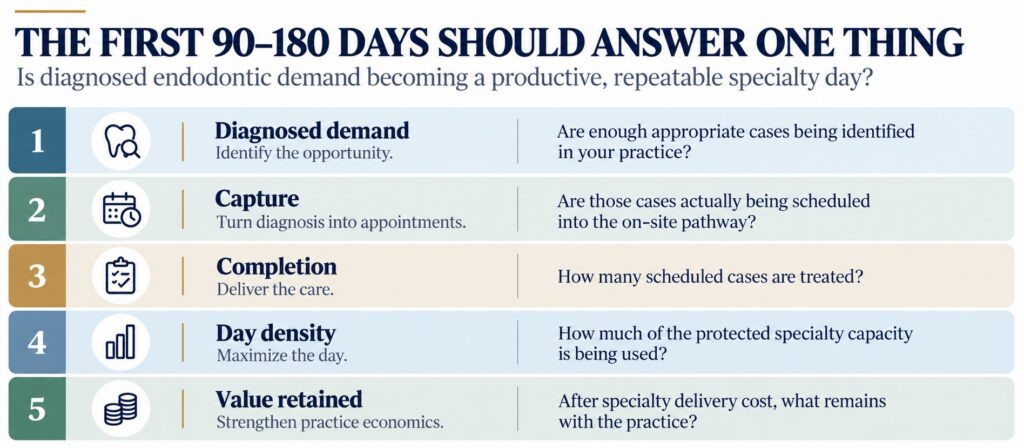
The sequence matters. If diagnosed demand is weak, the practice may not have enough volume. If demand is strong but capture is low, the problem is usually workflow or treatment presentation. If capture is strong but completion is weak, patient readiness and cancellation behavior deserve attention. If completion is strong but the specialty day is still light, the cadence may be wrong. The numbers tell the practice which operating problem it actually has.
THE TAKEAWAY
The Economic Advantage Comes From Matching Specialty Capacity to Existing Demand
The financial case for on-site endodontics starts with where the case goes today. Cases currently referred out create retained endodontic production when they are treated on-site. Cases currently performed by the GP create a different opportunity: specialist treatment preserves the endodontic production while releasing GP capacity for other productive care. Both opportunities become stronger when the practice can create dense specialty days, when the cost of unused specialist capacity sits in the right place, and when the patient moves through diagnosis, endodontic treatment and restoration with fewer handoffs. Those are the operating advantages that turn existing endodontic demand into a stronger economic result.
That is why two practices charging the same endodontic fee can have completely different results from the same concept. The economics live in the operating model, not in the fee schedule alone.
What a Practice Should Know Before It Decides
Before committing to recurring on-site specialty care, a practice should be able to answer five practical questions:
- How many appropriate cases are currently referred out?
- How many are currently performed by the GPs?
- How many of those cases can be consolidated into a productive specialty day?
- After the specialty delivery cost is paid, what remains with the practice from each retained case?
- Who carries the cost when specialist capacity is not fully used?
Those answers are enough to build a first-pass model. The first several months then test whether the assumptions survive contact with real scheduling behavior, patient completion and clinical-day utilization.
RELATED ENDOCONNECT INSIGHTS
What Is On-Site Endodontic Care? How It Differs From the Traditional Referral Model
What an On-Site Endodontic Day Actually Looks Like
General Dentist vs. Endodontist: Where the GP’s Time Is Best Spent
When Does It Make Sense to Bring Endodontic Care Into a General Dental Practice?
LEARN HOW ENDOCONNECT WORKS
See how on-site endodontic care is integrated into the practice, including scheduling, staffing, equipment and workflow.
EXPLORE PARTNERSHIP OPPORTUNITIES
See whether your practice or group may be a fit for recurring on-site endodontic care.