
General Dentist vs. Endodontist: Where the GP’s Time Is Best Spent
The referral decision is usually framed around clinical capability. In a growing practice, it is also a resource-allocation decision because the most constrained resource in the office is often the general dentist’s time.
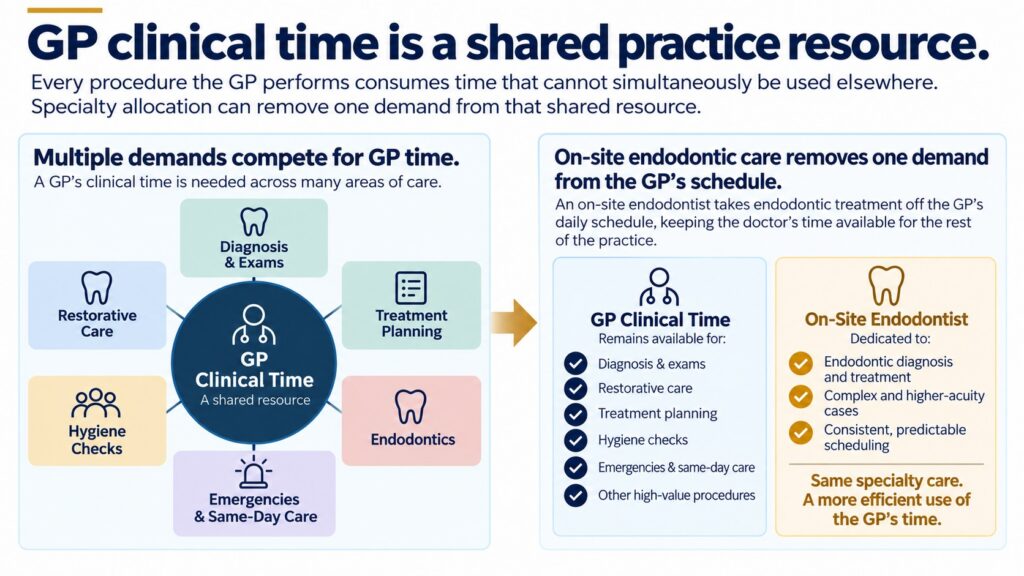
THE KEY DISTINCTION
Clinical capability answers whether a GP can perform the case. Resource allocation answers whether the GP should be the person performing it.
For decades, the endodontic decision inside a general dental practice has been treated as a binary clinical question: can the general dentist do this case, or should it be referred? That question is necessary, but it is incomplete. A dentist may be fully capable of performing a root canal and still not be the highest-value person to spend the next 90 minutes doing it. That distinction matters more as practices grow. Doctor time is finite. A general dentist can diagnose across the entire mouth, sequence complex treatment, restore teeth, manage emergencies, lead case acceptance, and make the clinical decisions that drive nearly every other part of the practice. When that doctor spends a long block on a procedure that can be performed by a specialist, the practice is making an allocation decision whether it recognizes it or not.
Clinical capability remains an important part of the endodontic decision, but it is only one variable. In a growing practice, case difficulty should be considered alongside patient needs, doctor capacity, and the value of the GP’s time elsewhere in the practice. Together, those factors provide a more complete basis for deciding who should perform the treatment.
Capability and allocation are different decisions
General dentists appropriately perform a substantial share of endodontic treatment in the United States. National survey data have shown that general dentists perform the majority of root canal therapy, and the American Association of Endodontists’ own case-difficulty framework recognizes that routine, low-difficulty cases can be appropriately managed by a competent general dentist. Referral becomes increasingly important as case complexity exceeds the practitioner’s experience or comfort. Endodontics, therefore, can fit well within general practice. However, for a growing practice, the additional consideration is how much of the general dentist’s finite clinical capacity should be allocated to performing it.
Specialization also changes how clinical time is structured. Endodontists complete advanced specialty training and devote their practices to the diagnosis and treatment of pulpal and periapical disease. The American Association of Endodontists reports that an endodontist performs roughly 25 root canal treatments in an average week, compared with about two for a general dentist. That concentration makes endodontic treatment a routine part of the specialist’s daily workflow rather than one of many competing demands on the doctor’s schedule.
For the general dentist, the same block of clinical time may otherwise be used for examinations, restorative care, treatment planning, hygiene checks, emergencies, and other procedures that depend on the GP. The significance is not that one clinician is inherently more capable than the other. It is that the opportunity cost of their time is different.
THE TAKEAWAY
A practice does not have to choose between respecting GP capability and recognizing specialist leverage. Both can be true.
The GP is usually the practice’s most constrained clinical asset
The economics of doctor time are often hidden because the schedule makes every procedure look like an isolated production event. A root canal has a fee. A crown has a fee. A new-patient exam may have little immediate production at all. Looking only at the fee attached to the procedure can therefore make the decision seem simple: if the practice can collect the root canal fee, why would it pay someone else to perform it? Because the fee is not the scarce resource. The doctor’s time is.
A general dentist’s highest-leverage work is not always the procedure with the largest fee in that moment. A 90-minute block might alternatively be used to diagnose and present a full-mouth case, complete restorative dentistry that only the GP can perform, convert an emergency into definitive treatment, keep a high-value restorative schedule on time or open capacity for another patient. Some of those activities generate immediate production; others create downstream production. All of them compete for the same doctor minutes. This is why the right unit of analysis is not “production per procedure.” It is the total contribution created by a scarce hour of doctor capacity—including what the practice gives up by using that hour one way instead of another.
Case difficulty is only one axis
The traditional referral threshold is mostly clinical: straightforward anterior and premolar cases stay with the GP, difficult molars and retreatments go to the endodontist. That framework is sensible clinically, but it assumes the value of the GP’s time is constant. It is not. Consider the same routine premolar in two practices. In the first, the dentist has open chair time, enjoys endodontics, works efficiently, and would not replace the 90-minute block with other productive care. Keeping the case may be entirely rational. In the second, the doctor is booked three weeks out, restorative treatment is waiting, new-patient exams are being squeezed into lunch, and endodontic cases routinely push the schedule late. The clinical case did not change. The opportunity cost did.
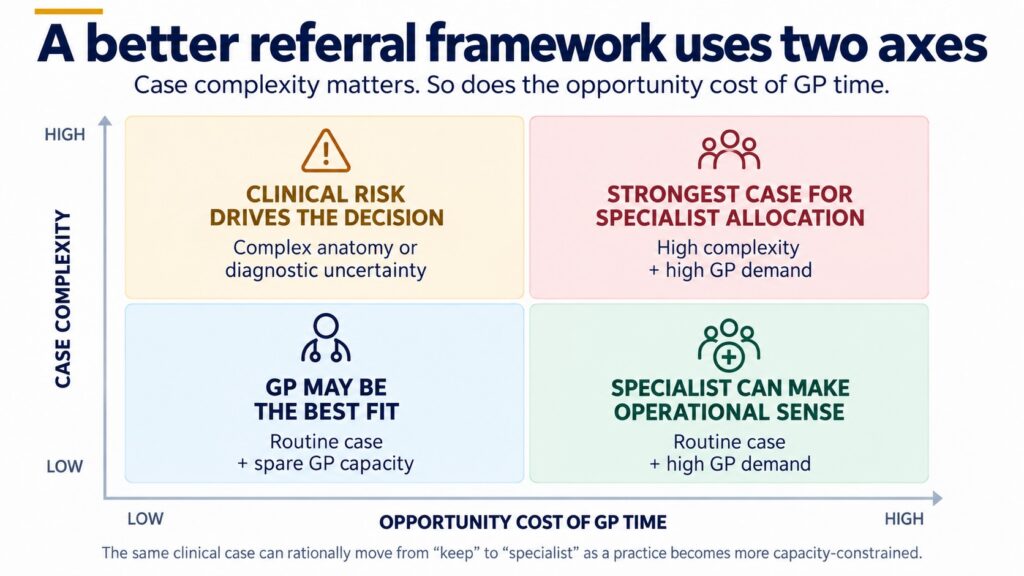
This two-axis view is the key shift. Complexity tells the practice how much specialty expertise the case may require. Opportunity cost tells the practice how expensive it is to use the GP for work that another qualified clinician could perform. As either variable rises, the threshold for specialist allocation should change.
Compare total contribution, not just the endodontic fee
The most common economic mistake is to compare the specialist’s fee with zero. That makes any specialist look expensive. But “the GP does it” is not a zero-cost alternative. It consumes doctor time, assistant time, room capacity, supplies, and, most importantly, the value of whatever the GP could have done during the same block. A more accurate comparison looks at the whole practice. Under a GP-performed model, the practice keeps the contribution generated by the root canal. Under a specialist model, the practice keeps whatever margin remains on the endodontic case and also regains the GP time. If that regained time is filled with productive general dentistry, both value streams belong in the comparison.
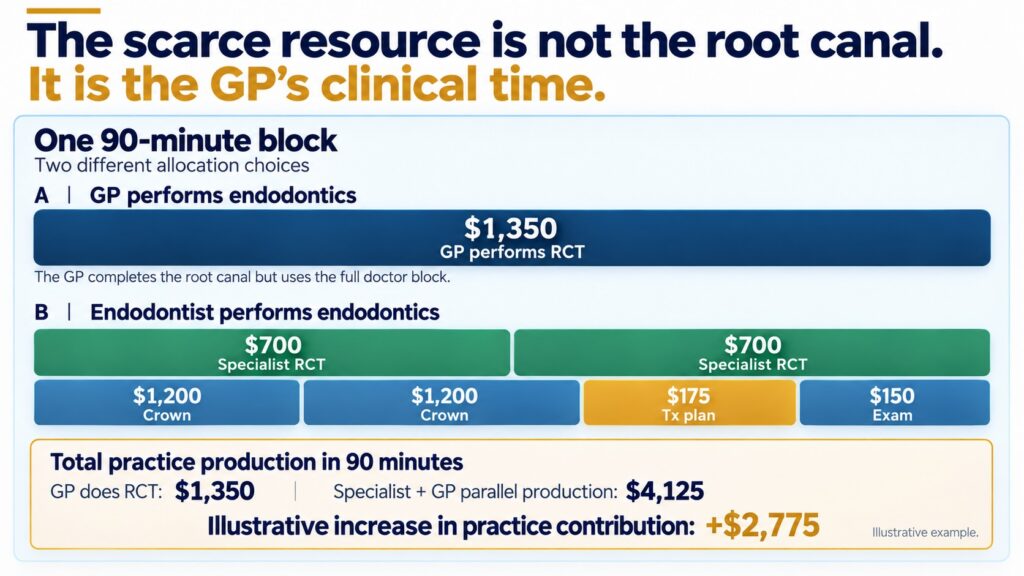
A specialist model can produce more total practice contribution even when the retained margin on the endodontic case is smaller—if the GP time is productively redeployed. Numbers shown are illustrative, not a fee recommendation.
The inverse is equally important: if the GP’s freed time simply becomes an open chair, the economics may not work. Specialty coverage does not create value merely by existing. It creates value when the practice has sufficient demand and can convert released doctor capacity into other needed care.
HIDDEN DENOMINATOR
The value of specialization depends on what happens to the time it frees. Capacity that is released but not redeployed has little economic value.
The correct answer can change as the practice grows
One reason practices struggle with this decision is that they treat the referral threshold as a permanent expression of clinical philosophy. In reality, the threshold should evolve with the practice. A dentist in an early-stage practice may rationally perform a broad range of procedures because available doctor capacity exceeds patient demand. Performing endodontics keeps production in the schedule and makes use of time that might otherwise go unfilled. Several years later, that same doctor may have a full restorative schedule, a steady stream of new patients, more complex treatment plans, and less tolerance for unpredictable chair time. The same root canal can now be a poor use of the doctor’s schedule even though the dentist is more experienced than before.
That is not inconsistency. It is a sign that the constraint moved. Early on, the constraint was patient demand. Later, the constraint became doctor capacity. Healthy practices change operating models when their bottleneck changes.
RELATED AUTHORITY PIECE 05
The Economics of On-Site Endodontics
On-site endodontics creates a third option
Historically, the decision had two practical outcomes: the GP performed the case, or the patient left the practice for a specialist. Each solved one problem while creating another. GP-performed care preserved continuity and procedure economics but consumed doctor time. Traditional referral released doctor time and brought specialty expertise to the case, but moved the patient, scheduling process, and procedure economics outside the dental home. On-site specialty care changes that equation. When an endodontist treats inside the general dental practice on scheduled clinical days, the practice can free the GP, keep the patient within the existing dental home, preserve control of the patient experience, and retain a portion of the economics associated with the procedure. That does not make on-site care automatically superior; it simply creates an operating model that did not exist in the old “do it or refer it” framework.
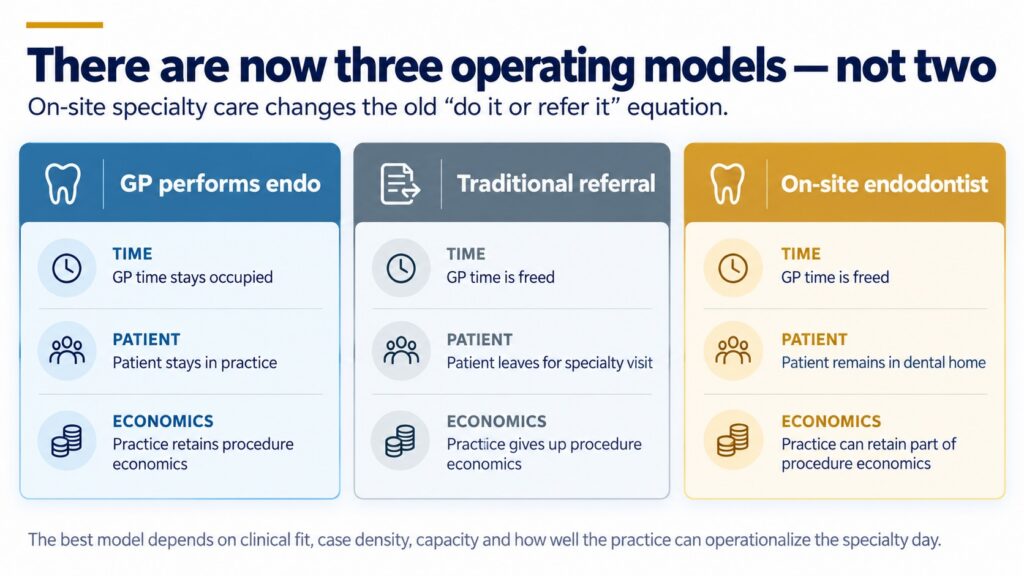
For the model to work, however, the practice needs real case density, disciplined scheduling, appropriate operatories, clear clinical alignment, and a reliable specialty team. A sporadic case here and there does not create an operating model. It creates complexity. The value appears when the practice can concentrate enough appropriate treatment into a repeatable cadence.
A five-number test is more useful than intuition
Practices do not need a complicated financial model to evaluate the decision. They need five numbers that are usually available or can be measured within a few weeks. The first is the actual amount of GP time consumed by an endodontic case, not just the estimated procedure time. The second is the contribution the GP can reliably generate per freed hour elsewhere in the schedule. The third is the contribution the practice retains when the specialist performs the case. The fourth is the redeployment rate: how much of the released GP capacity will actually be filled with productive care. The fifth is the number of cases currently referred out each month. Referred cases reveal demand that already exists but is leaving the practice. That volume can materially change the economics of bringing specialty care on-site.
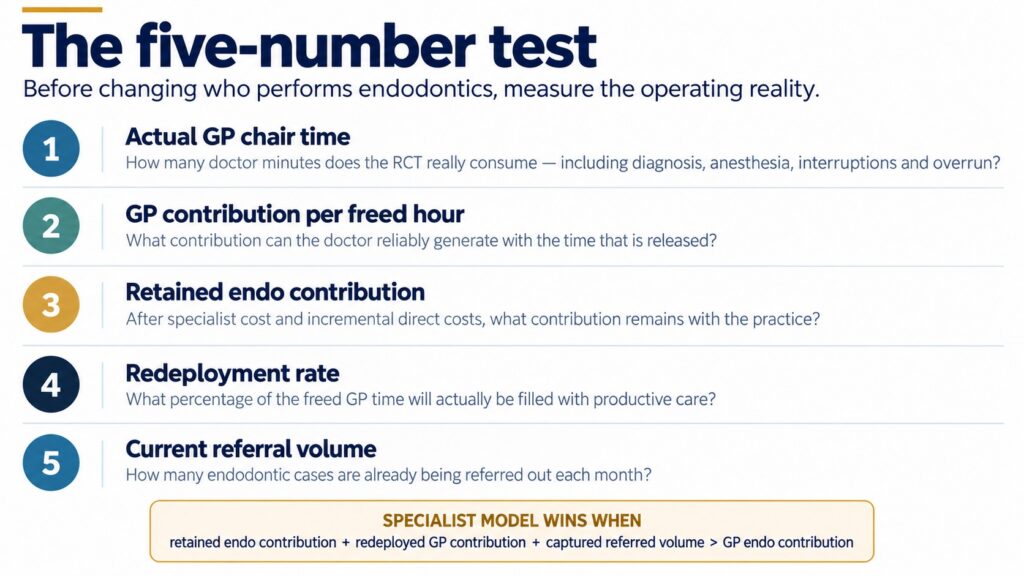
The five-number test turns the decision into an operating calculation. Clinical appropriateness remains a separate threshold that must be met first.
In simple terms, specialist allocation creates more economic value when the retained endodontic margin plus the contribution created by redeployed GP time exceeds the contribution the GP would have generated by performing the endodontic case. That formula is intentionally uncomplicated. Its strength is that it forces the practice to measure the variable most often ignored: what the GP will do instead.
When GP-performed endodontics still makes sense
There are many situations in which the GP should keep the case. A dentist may have excellent endodontic training, enjoy the procedure, work efficiently, have appropriate technology, and produce consistent outcomes. The practice may have available doctor capacity, modest restorative demand, or geography that makes specialty coverage impractical. In those circumstances, moving routine endodontics away from the GP can reduce rather than increase total value. The framework is designed to use right clinician for the right case in the right operating environment. If the GP is clinically comfortable and the opportunity cost of the doctor’s time is low, there may be no operational problem to solve.
When specialist allocation becomes a capacity strategy
The signal changes when the practice is repeatedly short on doctor time. If comprehensive exams are difficult to schedule, restorative treatment is delayed, the doctor is chronically running behind on endodontic days, emergency patients displace planned care, or the practice is referring a meaningful volume of diagnosed treatment out of the office, the issue is no longer simply case selection. It is capacity design. In that environment, the endodontist is not merely a referral destination. The specialist becomes a way to reserve GP time for work that depends uniquely on the GP while assigning endodontic treatment to a clinician whose practice is built around it. The practice can then judge the model by whether patient care stays timely, the schedule becomes more predictable, and total practice contribution improves, not by whether the GP was technically capable of doing the root canal.
The decision is not a referendum on clinical competence
Dentistry has traditionally attached professional identity to procedure ownership: if a dentist can perform a procedure, giving it to a specialist can feel like giving something up. That is the wrong frame for a growing organization. Mature clinical systems do not ask every highly trained professional to perform every task they are capable of performing. They allocate scarce expertise where it creates the most value. The general dentist’s broad clinical range is exactly why the GP’s time becomes so valuable. The endodontist’s narrow focus is exactly why specialty procedures can often be concentrated efficiently. Those are complementary roles, not competing ones.
A CAPACITY TEST
When a root canal is removed from the GP’s schedule, the value comes from what that time makes possible: more productive use of the doctor, better access for patients, and greater total contribution to the practice.
Clinical Judgment, Then Capacity
The first question in every endodontic case should remain clinical: what is the safest, most predictable way to treat this tooth? But once more than one clinically appropriate option exists, the practice should ask a second question: who should spend the time? For some practices, the answer will remain the GP. For others, especially practices where doctor capacity is the bottleneck, the better use of the GP may be diagnosis, comprehensive treatment planning, restorative dentistry, and the procedures that cannot be shifted to another qualified clinician. In those practices, bringing endodontic expertise to the patient can be more than a referral decision. It can be a capacity strategy.
That is the larger point. The modern practice should not evaluate endodontics only by whether the general dentist can do it. It should evaluate where each clinician’s time creates the best clinical and economic system for the patient.
Evidence Note & References
This article focuses on how practices allocate endodontic care when more than one clinically appropriate option exists. General dentists appropriately perform many root canal treatments, while endodontists bring specialty training and concentrated procedural experience. The decision remains case-specific and should account for clinical complexity, patient needs, doctor capacity, and practice workflow
1. Savani GM, Sabbah W, Sedgley CM, Whitten B. Current trends in endodontic treatment by general dental practitioners: report of a United States national survey. Journal of Endodontics. 2014;40(5):618–624. doi:10.1016/j.joen.2014.01.029.
Source
2. American Association of Endodontists.Endodontic Case Difficulty Assessment Form and Guidelines. The framework identifies low-, moderate-, and high-difficulty cases and may be used to assist with case selection and referral decisions.
Source
3. American Association of Endodontists.What’s the Difference Between a Dentist and an Endodontist? Advanced specialty-training and procedure-volume context. The AAE reports that endodontists complete an average of approximately 25 root canal treatments per week compared with about two for general dentists.
Source