
What an On-Site Endodontic Day Actually Looks Like
A practical look at the clinical flow, patient handoffs and operating discipline behind a well-run on-site endodontic day.
THE KEY IDEA
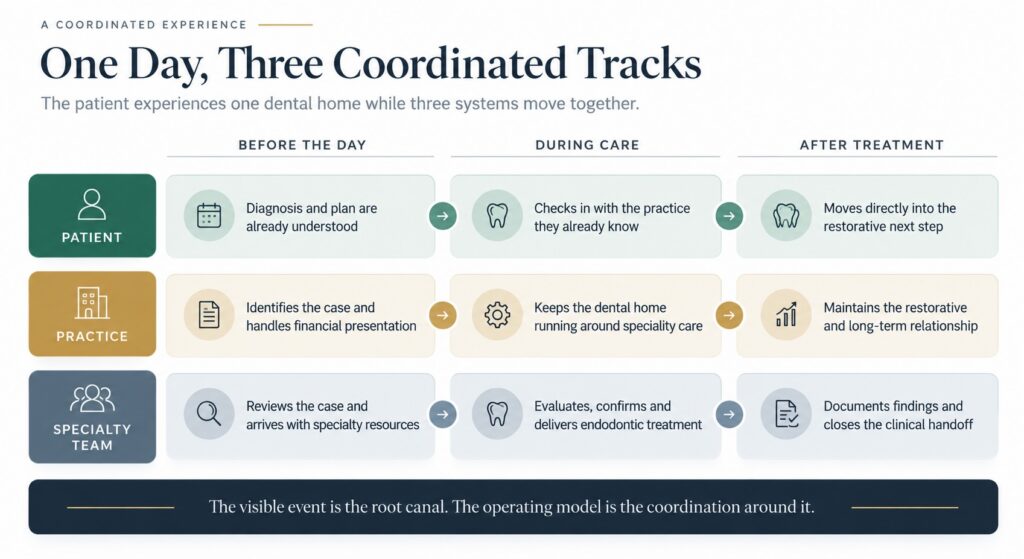
On-site endodontics is not simply a specialist performing root canals in a different building. It is a specialty day designed to fit inside the practice without forcing the practice to become an endodontic office.
The Day Is the Product
When a practice first considers keeping endodontic treatment in-house, the obvious question is usually clinical: Where will the endodontist work, and what equipment will be needed? Those questions matter, but they are not what determines whether the model succeeds.
The real product is the day itself. A successful on-site endodontic day is a coordinated operating system: the right cases are identified in advance, patients know what to expect, rooms are protected, the specialist arrives with a trained team and specialty equipment, and the practice knows exactly which responsibilities remain theirs.
When those pieces are aligned, specialty care can happen inside a general dental practice without asking the general dentist to become the specialist, the front desk to invent a new workflow on the fly, or the patient to leave the dental home to complete the next step of care.
The Day Starts Before the Endodontist Arrives
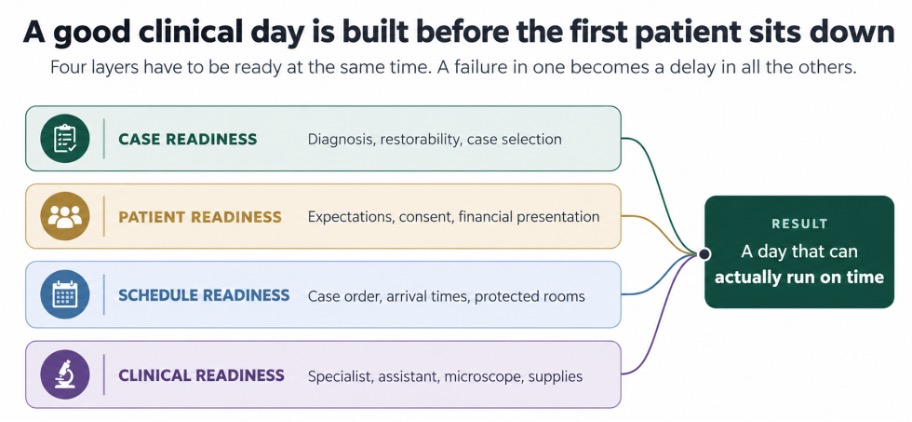
The strongest on-site days are largely won or lost before the clinical team walks through the door. Cases have already been identified. The practice has completed the financial conversation. Patients have been placed into a schedule built for endodontic flow rather than inserted into whatever openings happen to remain.
That distinction matters. A specialist day should not feel like a normal hygiene or restorative schedule with a root canal squeezed into the gaps. Endodontic procedures vary by tooth, anatomy, diagnosis and difficulty. The schedule needs enough structure to protect the clinical work while still using the specialist’s time efficiently. In the EndoConnect model, a partner office is expected to have a minimum viable case load for the visit, and the day is designed around a fuller clinical cadence rather than a one- or two-patient drop-in. The point is not volume for volume’s sake. The point is to create enough density that the specialist, assistant, equipment and practice resources are being used as an actual service line instead of an occasional accommodation.
The Practice Does Not Have to Build an Endodontic Department
The practice provides the dental home, the operatories, and the patient relationship. The on-site specialty team brings the endodontist, specialty-trained assistance, endodontic equipment and supplies, and the clinical workflow required to perform the treatment. That separation is important because consistently delivering specialty care requires more than simply placing a specialist in an available operatory. The clinical environment has to support the care being delivered. That means having the right personnel, instrumentation, materials, magnification, supplies, and workflows in place each time the specialist is on-site.
The operating microscope is one visible example. The American Association of Endodontists describes the dental operating microscope as providing the highest level of illumination and magnification and notes its value in complex anatomy and other challenging situations.¹ But the microscope is only one component of a broader specialty-ready clinical system. The same principle applies to trained chairside support, endodontic instrumentation, materials, and the processes surrounding treatment. The practical advantage for the practice is that it does not have to assemble those capabilities independently. Rather than building an endodontic department around occasional specialty care, the necessary clinical resources arrive together as part of the on-site model. The practice provides the setting and maintains the patient relationship; the specialty team provides the clinical capability required to deliver the care consistently.
What Stays With the Practice
The practice still owns the patient relationship: identifying cases, presenting treatment, scheduling the specialty day, setting patient fees and collecting payment or insurance. The specialist team owns the specialty clinical workflow.
The Specialty Day Is Integrated, Not Bolted On
An on-site specialty day should not take over the practice. It should create a defined lane of specialty capacity inside an office that continues functioning as a general dental practice. The patient still checks in through the practice. The practice still controls its financial processes and patient relationship. The general dentist still owns the restorative plan. The endodontic team owns the specialty clinical work. That distinction is what separates a scalable operating model from simply having a specialist visit an office. At this level a successful specialty day must have protected capacity, clear ownership and enough case density to function as a real service line without disrupting the rest of the practice. Scheduling templates, case order and room sequencing still matter, but those are implementation tools rather than the model itself.
Specialty Care Has to Be Designed Around the Specialist
Bringing specialty care into a general dental practice works best when the surrounding environment is designed to let the specialist remain focused on the work that requires specialist judgment and skill. That does not mean rushing treatment or compressing clinical decision-making. It means organizing the people, space, equipment, and supporting tasks so that the specialist is not repeatedly pulled away from treatment by activities that can occur before, after, or alongside the procedure. This is an important distinction. The efficiency of an on-site specialty model does not come from asking the endodontist to work faster. It comes from designing the clinical environment so that specialist time is used where it creates the most value.
What the Patient Actually Experiences
From the patient’s perspective, the day should feel much less complicated than the operating system behind it. The patient checks in with the practice they already know. The office’s normal financial and administrative processes remain familiar. The endodontist evaluates the tooth, confirms the diagnosis and treatment plan, obtains the necessary consent, and performs specialty treatment inside the practice. The clinical steps of root canal treatment still follow endodontic standards. Appropriate imaging, isolation, diagnosis, treatment planning and case difficulty assessment remain clinical requirements regardless of where the care is delivered.³
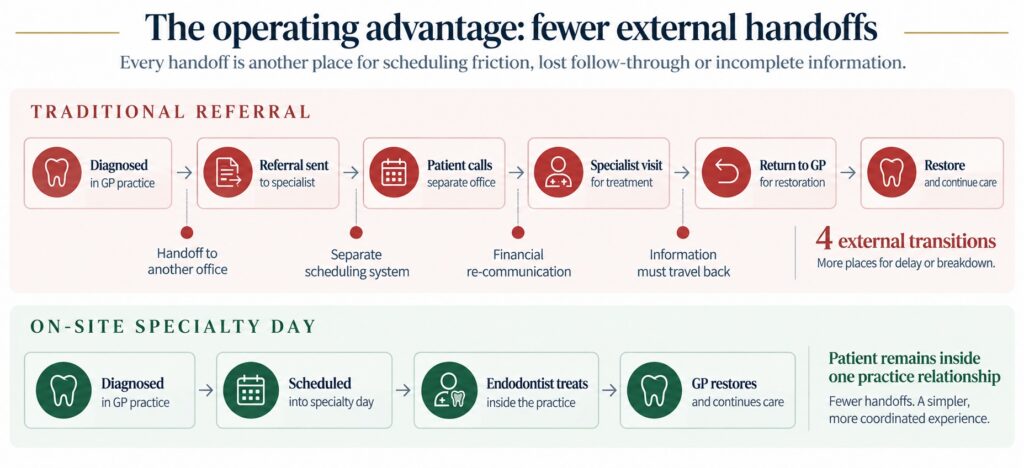
What changes is the patient journey around those clinical steps. Instead of leaving with a referral and beginning a second scheduling process with another office, the specialty appointment can be coordinated through the patient’s existing dental home.
What the General Dentist Is Doing While the Endodontist Treats
The general dentist does not have to stop being productive in order to make the specialty day work. That is one of the most important differences between bringing an endodontist into the practice and simply asking the GP to do more endodontics. While the endodontist treats the cases selected for specialty care, the general dentist can continue doing the work where the practice most needs the GP’s time: restorative treatment, exams, comprehensive care, treatment planning and other procedures. The endodontist is not replacing the GP. The model is reallocating the right clinical work to the right clinician.
That distinction becomes more meaningful as a practice grows. The constraint is often not whether a general dentist is technically capable of treating a straightforward root canal. The constraint is where limited doctor time creates the most value for patients and for the practice.
The Best Days Feel Predictable, Not Rushed
A high-functioning specialty day should not feel like an emergency clinic. It should feel controlled. The specialist knows the case mix. The assistants know the sequence. The practice knows which patients are coming and what has already been presented. The rooms are protected and equipment is ready. That predictability is what makes a fuller clinical day possible. In a well-built schedule, six completed treatments can be a design target without turning the day into a race. The number is less important than the operating principle: reduce avoidable waiting, not clinically necessary time.
A USEFUL TEST
If the only way the schedule works is for every procedure to finish at the fastest possible time, the schedule is too fragile. A good system has enough structure to survive normal clinical variation.
The Restorative Handoff Happens Inside the Same Care Relationship
Endodontic treatment is not the end of the tooth’s care. The restorative plan still matters. After treatment, the specialist communicates the clinical findings and next steps so the general dentist can complete the definitive restoration when appropriate. Keeping that handoff inside the same practice relationship can make the sequence easier to coordinate. The patient does not have to interpret instructions between two unrelated offices, and the restorative team has a direct path back to the treating specialist when a question arises.
In some practice workflows, consolidating specialty treatment into the dental home can also reduce the number of separate office visits around diagnosis, specialty treatment and restoration. The exact number depends on the case, but the operational goal is straightforward: eliminate visits and transitions that exist only because care is split between offices.
The Last Patient Is Not the End of the Day
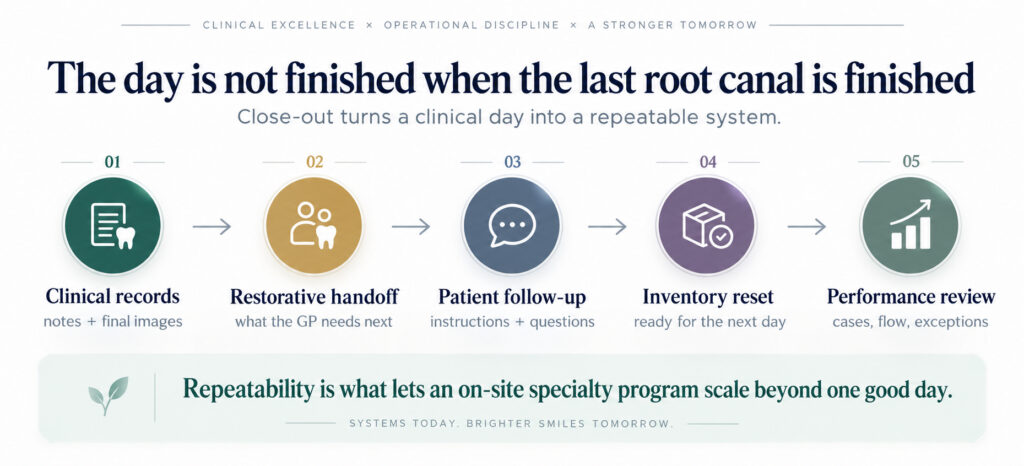
A specialty program becomes scalable only when the close-out is as disciplined as the setup. Clinical notes and final imaging must be complete. Restorative instructions need to be clear. Patient questions and post-operative communication need an owner. Supplies have to be reset. The practice and specialty team should know whether anything unusual happened that needs follow-up before the next visit. This is also where the model begins to generate useful operating data. Over time, practices can look at how many cases were identified, scheduled and completed; whether the planned day was fully utilized; where cancellations or gaps occurred; and whether case flow is becoming more predictable.
Where an On-Site Day Usually Breaks Down
The clinical procedure is rarely the only reason an on-site program underperforms. More often, the friction shows up in the handoffs around it. Cases are identified but never scheduled. A patient is placed on the day before the financial conversation is complete. The office holds one operatory instead of protecting the room flow. Cases are added late without enough information. The team treats the specialist day as an exception instead of a recurring operating process. Those failures are useful because they are fixable. They also explain why a short “trial day” can be misleading. The model needs enough repetition for the office to learn the cadence, build a case pipeline and make the workflow normal. A single day can prove that the endodontist can work in the office. It cannot prove that the practice has built a reliable in-house specialty system.
What On-Site Endodontics Is and Is Not
On-site endodontics is not a mobile dental clinic, a temporary doctor filling a staffing gap, or a general dentist simply deciding to do more root canals. It is a recurring specialty service embedded inside a general dental practice while keeping the practice’s patient relationship, fees and restorative care in place.
That matters because location alone does not create a new model. A specialist can physically work in another office and still create chaos if the cases, schedule, team and responsibilities are not designed around the day. The operating system is what makes the care scalable.
The Takeaway
A good on-site endodontic day is almost invisible to the patient. The complexity is absorbed by the operating model: cases are ready, rooms are ready, the specialty team is ready, and the general practice continues functioning around the care.
That is the standard practices should use when evaluating whether keeping endodontic treatment in-house makes sense. The question is not simply whether an endodontist can come to the office. The question is whether the practice can create a repeatable clinical day in which specialist care fits naturally into the dental home.
Selected Clinical References
1. American Association of Endodontists. “Microscopes in Endodontics.”
2. American Association of Endodontists. “Root Canal Treatment.”
3. American Association of Endodontists. “Treatment Standards: Executive Summary.”
Editorial note: The workflow illustrations describe the EndoConnect operating model and are not clinical timing standards. Exact case duration, imaging, anesthesia, treatment and restorative recommendations depend on diagnosis, anatomy, complexity and clinical judgment.