
When Does It Make Sense to Bring Endodontic Care Into a General Dental Practice?
For most general dental practices, referring endodontic treatment to an outside specialist has long been the default. That model remains appropriate in many situations. But as a practice grows, there can come a point when routinely sending every endodontic case elsewhere creates unnecessary friction for the patient and the practice.
On-site endodontic care becomes worth evaluating when a practice already has recurring patient need, sufficient case volume, available clinical space, and a team capable of organizing treatment into predictable specialty days. The starting point is usually much simpler than practices expect: look at the endodontic treatment already moving through the practice.

On-site endodontic care brings specialist treatment into the patient’s existing dental practice.
Start With the Endodontic Cases You Already Have
Practices do not need to create additional demand to determine whether on-site endodontic care may fit. Start with the treatment already being diagnosed.
Endodontic cases often appear one at a time: a patient with pain on Monday, a cracked tooth later in the week, an emergency examination the following month. In a multi-doctor or multi-location practice, those cases may be distributed across several providers and schedules. Because each referral leaves individually, the total volume can be easy to underestimate.
Looking back over several months provides a clearer picture. How many endodontic cases were diagnosed? How many were referred externally? How many were completed by general dentists? How many diagnosed patients ultimately completed treatment? Viewed collectively, a group of seemingly isolated cases may represent enough recurring demand to support a scheduled specialty day.
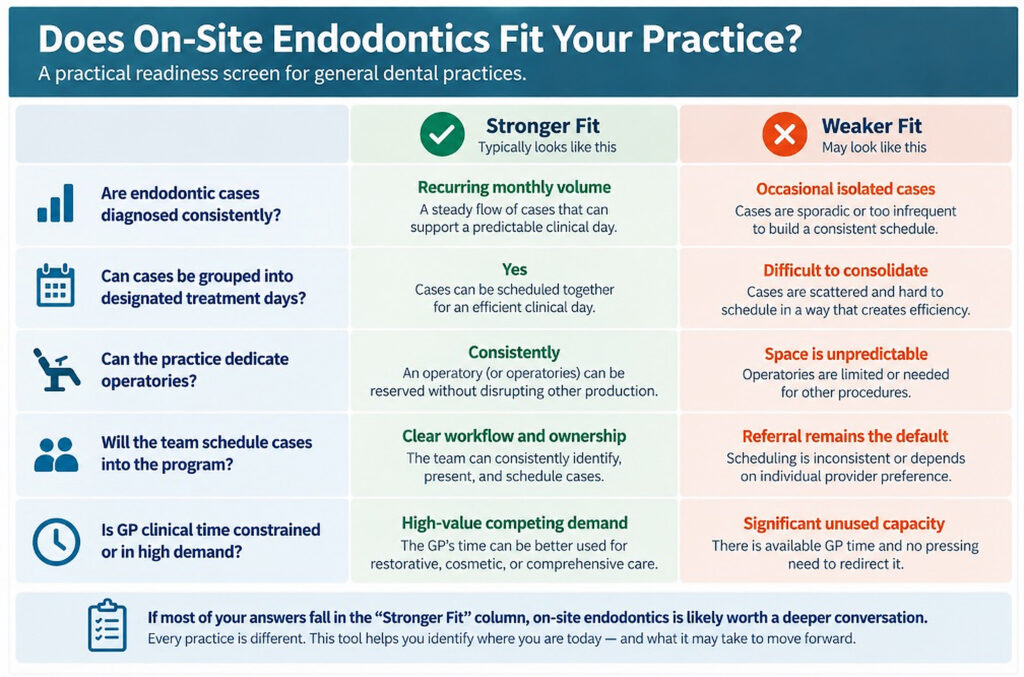
Volume is only one component of fit. Scheduling discipline, clinical space and team adoption also determine whether an on-site model can work consistently.
Volume Matters — but Volume Alone Is Not Enough
There needs to be enough appropriate treatment to support a productive specialty day. A practice that encounters only an occasional endodontic case may be better served by maintaining a strong external referral relationship. Practices with sufficient volume still need the operational ability to organize that volume.
The team must reliably identify appropriate cases, communicate the treatment pathway to patients, schedule those patients into designated specialty days and coordinate the restorative care that follows. This is where implementation becomes important. An endodontist can be available inside the practice, but availability alone does not create a functioning specialty program. The clinical day has to become part of the practice’s normal operating rhythm. Consistent case identification and scheduling are therefore just as important as the raw number of procedures.
Look at What the General Dentists Are Doing Today
Some practices already keep a meaningful amount of endodontic treatment in-house because their general dentists perform the procedures themselves. Many general dentists are comfortable providing endodontic treatment, and there are situations where that is entirely appropriate.
The additional consideration is how the doctor’s clinical time is being used. A root canal that occupies a significant portion of a general dentist’s schedule uses time that could otherwise be available for restorative treatment, surgery, comprehensive examinations, treatment planning or other procedures. For a busy practice, that allocation of doctor time can matter considerably.
Bringing an endodontist into the practice allows the patient to remain within the same dental home while allowing the general dentist to continue providing the care for which the practice most needs that doctor’s time.
The greatest benefit to the practice may come not from having the GP perform all treatments, but from using that doctor’s clinical time where it creates the most value.
This becomes particularly relevant in practices where GP capacity, rather than patient demand, is the limiting factor.
Specialist Care Without Building a Specialty Department
Traditionally, a practice that wanted specialist care inside its organization faced a substantial commitment. Hiring an endodontist internally can require enough volume to support the provider, specialty equipment, staffing, clinical workflows, scheduling systems and the administrative burden of operating another specialty service. That level of infrastructure does not make sense for every practice.
An on-site model creates another option. The practice can schedule endodontic care on recurring clinical days while the specialist, specialty-trained support team, equipment, supplies and clinical workflow are brought into the existing practice. The general dental team continues managing the patient’s overall care.
Bringing endodontic treatment in-house does not necessarily require hiring an endodontist in-house. That distinction is central to the on-site model.
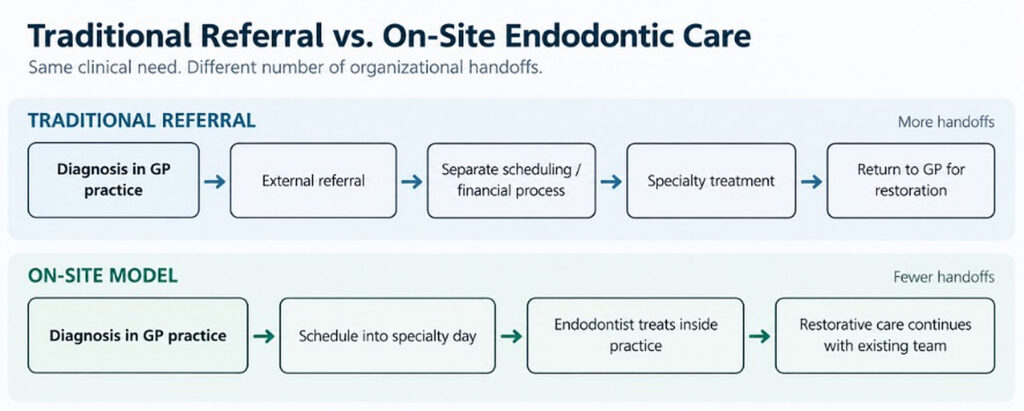
The clinical need may be the same, while the number of organizational handoffs can be substantially different.
Patient Continuity Is Part of the Equation
External referral remains an important part of dentistry and will continue to be appropriate for many patients and practices. It also creates another transition in the patient’s treatment journey. The patient may need to contact another office, provide information again, navigate a different financial process, schedule another appointment and then return to the general practice afterward for restorative treatment.
Most patients navigate that process successfully. Some delay treatment while others never complete it.
When appropriate specialty treatment can occur inside the general practice, the patient remains connected to the team that made the diagnosis. Specialty care takes place within a familiar dental environment, and the restorative plan can remain directly connected to the treatment that preceded it. That continuity is one of the practical reasons practices begin evaluating an on-site model.
Five Signals That a Practice May Be Ready
Several patterns can indicate that on-site endodontic care is worth evaluating.
1. Endodontic cases leave the office every month
Occasional referrals are normal. Recurring monthly referral volume suggests that enough existing demand may already be present to consider another delivery model.
2. Multiple doctors or locations contribute cases
Case volume that appears modest at the individual-provider level can become meaningful when treatment is viewed across an entire practice or dental group.
3. General dentists spend significant clinical time performing endodontics
In this situation, the opportunity may involve clinical capacity as much as referred-out treatment. Specialty care can allow the GP’s schedule to remain available for other treatment while the patient stays within the practice.
4. Patients encounter friction between diagnosis and treatment
Every additional scheduling, financial and administrative step introduces another point where treatment can be delayed or abandoned.
5. The practice can commit to recurring specialty days
On-site care works best when it becomes a predictable part of the practice’s operating model rather than an occasional accommodation.
A Better Way to Evaluate Demand
A practice does not need to estimate its potential endodontic demand from memory. A simple retrospective review can provide a much better answer. Look back approximately 90 days and identify the number of endodontic cases diagnosed, the number referred externally, the number performed by general dentists, and the number of diagnosed cases that did not ultimately complete treatment.
Then evaluate the operational side. Could the practice consistently make appropriate operatories available? Could cases be organized into recurring clinical days? Is the team prepared to schedule patients into that model? The result provides a much more realistic picture of opportunity than simply estimating how many root canals the practice performs in an average month.
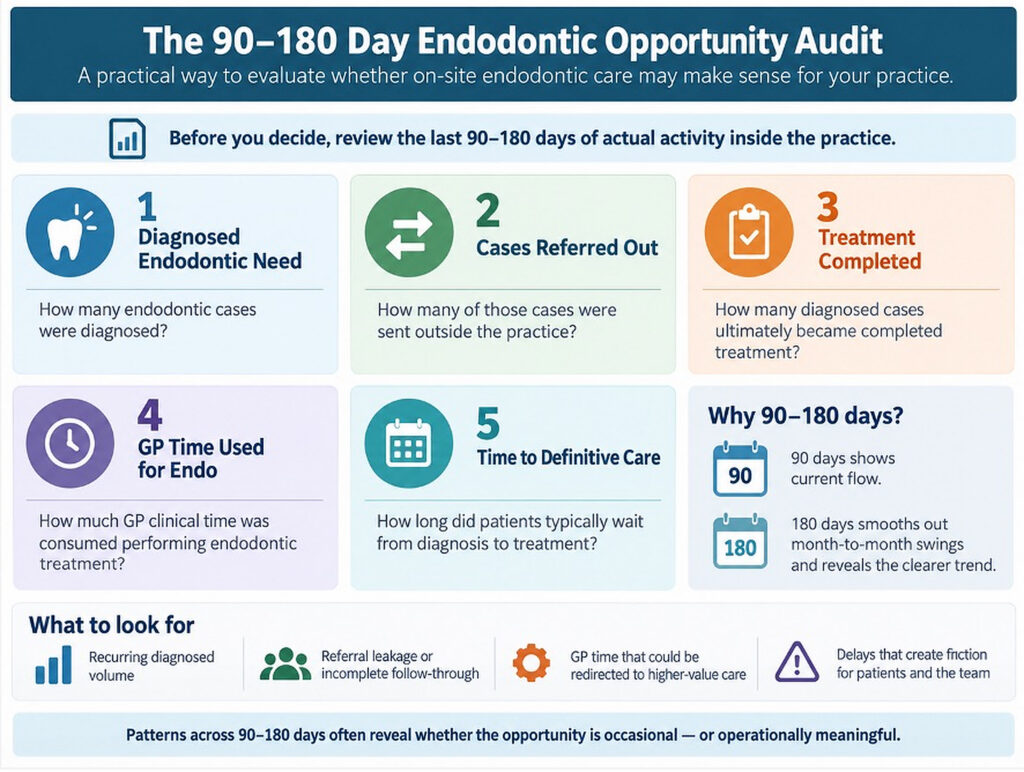
The strongest demand estimate usually comes from reviewing the treatment the practice is already diagnosing.
When On-Site Endodontics Probably Does Not Make Sense
On-site endodontic care is not appropriate for every practice. A practice with consistently low case volume may have difficulty creating efficient specialty days. Limited operatory availability can create conflicts with the existing general dentistry schedule. A team that cannot consistently identify and schedule appropriate cases may struggle to support predictable utilization. In those situations, a strong external referral relationship may remain the more practical model. There may also be individual cases that should continue to be treated outside the practice regardless of the overall delivery model.
The purpose of on-site specialty care is not to eliminate referrals. It is to create another treatment pathway for practices with enough recurring need and sufficient operational readiness to support it.
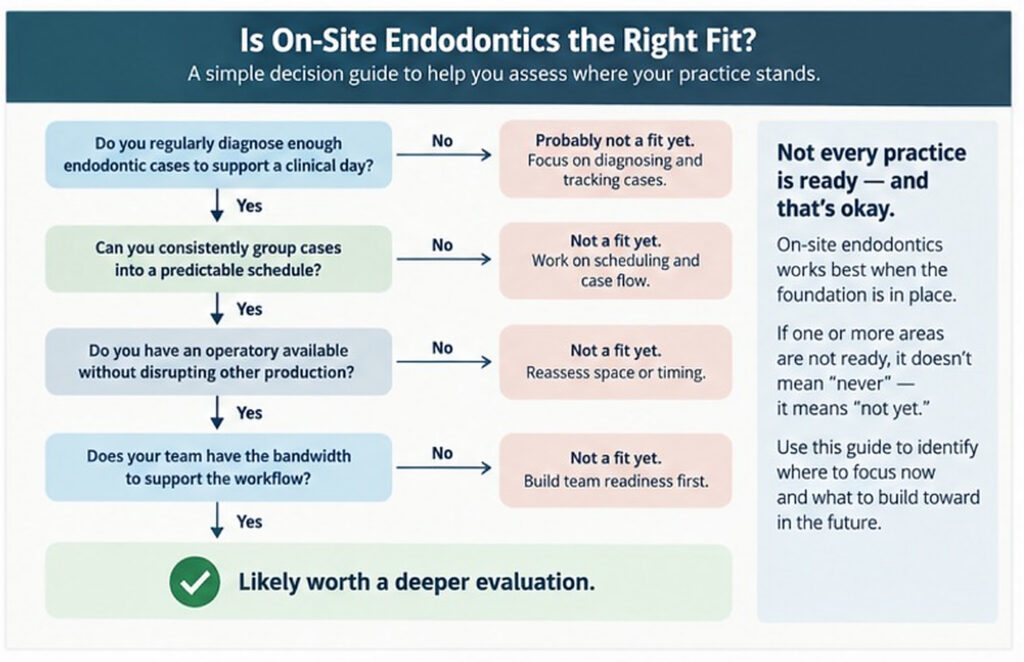
Economics Matter — After the Operating Model Makes Sense
Financial viability is another part of the decision. A practice should understand how many appropriate cases can realistically remain in-house, what it collects for those procedures, what specialty delivery costs, and what other clinical work may become possible when GP time is reallocated. Those economics deserve their own analysis.
An attractive financial model cannot compensate for inconsistent case flow, insufficient clinical space or poor scheduling execution. Conversely, a practice with strong operational fit should understand the financial implications before establishing recurring specialty days.
RELATED AUTHORITY PIECE 05
The Economics of On-Site Endodontics
An Additional Model for Specialty Care
General dental practices have traditionally relied on two primary options for endodontic treatment: the general dentist performs the procedure, or the patient is referred to an outside endodontist. On-site specialty care adds another option. An endodontist can provide treatment within the general dental practice on recurring clinical days without requiring the practice to permanently build and operate an internal endodontic department.
For practices with sufficient case flow and operational readiness, this can create a simpler path between diagnosis, specialty treatment and restorative follow-through. It also allows referral decisions to become more deliberate.
Some cases should leave the practice. Others may not need to. The practice can decide which pathway makes the most sense based on the patient, the case and the operating environment.
About EndoConnect
EndoConnect provides on-site endodontic care for dental practices and groups. The model includes the endodontist, specialty-trained assistants, equipment, supplies and clinical workflow needed to deliver specialty treatment within the partner practice.
The practice identifies appropriate cases, manages patient-facing fees and insurance, schedules patients into designated specialty days and maintains the broader restorative relationship. The result is a model designed to help practices keep appropriate endodontic treatment connected to the patient’s existing dental home.
LEARN HOW ENDOCONNECT WORKS
See how on-site endodontic care is integrated into the practice, including scheduling, staffing, equipment and workflow.
EXPLORE PARTNERSHIP OPPORTUNITIES
See whether your practice or group may be a fit for recurring on-site endodontic care.
Author
Gary R. Middleton, DDS
Founder & Lead Endodontist, EndoConnect